Why you lose easy Listening points — and the fix
In CELPIP Listening you hear each clip once, so the points you drop are usually memory, not comprehension. Here's the note-taking habit that catches them.

⚡ The short version
- Listening is 38 questions across 6 parts, and you hear each clip only once.
- Lost points are usually memory, not comprehension — take quick notes.
- Flag contrasts ('but', 'however') — they're frequent question targets.
CELPIP Listening is 38 questions across six parts, in roughly 47–55 minutes — and the detail that decides your score is this: you hear each clip once. There's no replay. That single rule explains almost every point people lose here, and it points straight at the fix.
You hear it once
The six parts move from a problem-solving conversation through everyday dialogue, an information segment, a news item, a discussion, and a viewpoints piece. They sound different, but they share that one constraint — by the time the question appears on screen, the audio is gone.
So the test isn't really measuring whether you understood. It's measuring whether you can hold the right details long enough to answer.
The points you lose are memory, not meaning
Most candidates who underperform here understood the clip perfectly. They just couldn't recall the specific number, name, or reason when the question came. That's a memory problem, and you don't solve it by listening "harder" — you solve it by getting the details onto paper as you go.
Note what gets tested
You can't write everything, so write the things CELPIP actually asks about:
- numbers (prices, times, dates, quantities),
- names (people, places),
- reasons ("because…"),
- changes of plan.
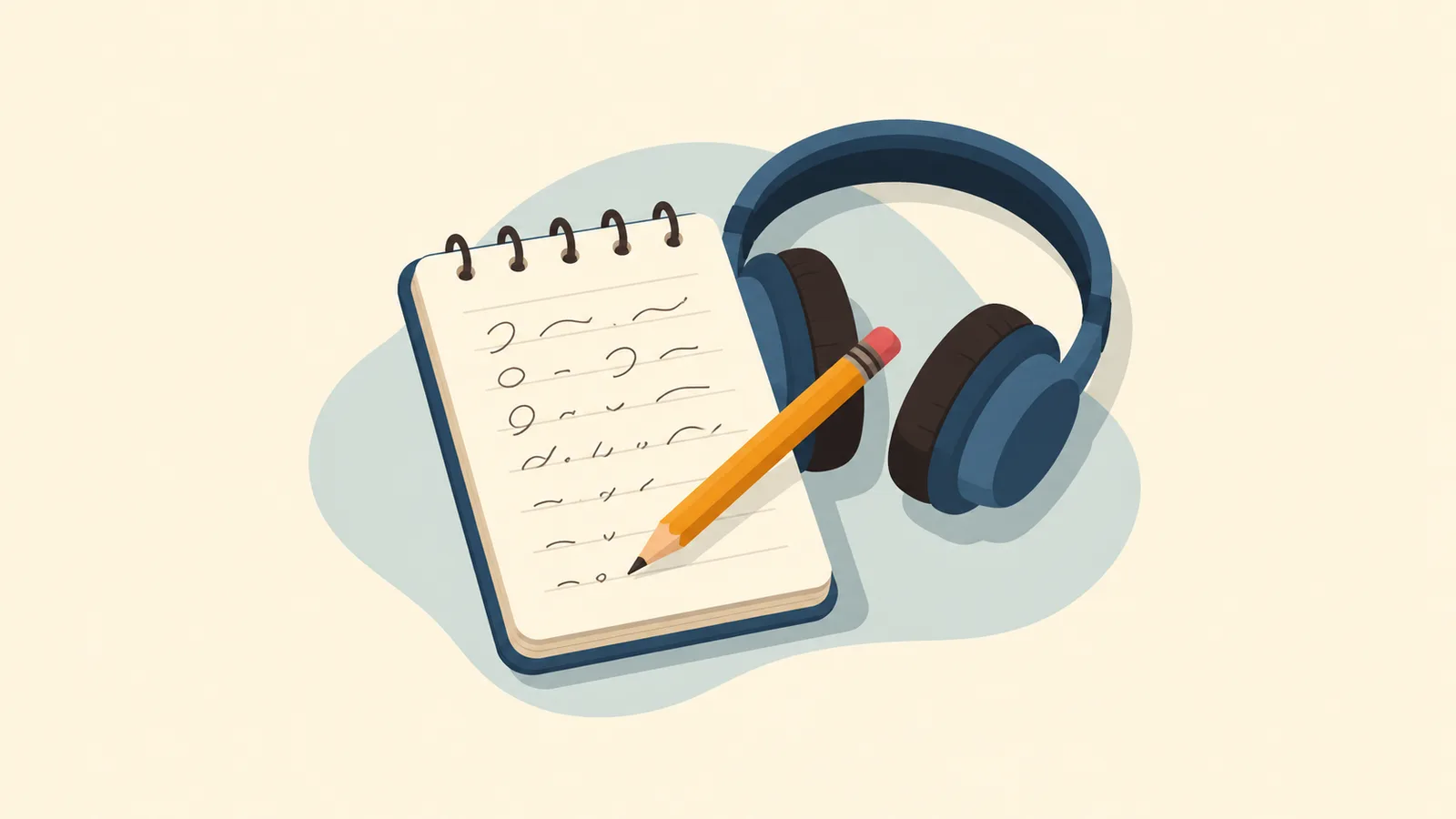
Two or three quick tokens per clip is plenty — shorthand, not sentences. The act of jotting them is what fixes them in memory, even if you barely glance at the notes again.
Predict the question while you listen
CELPIP loves to ask what changed or what the catch was. So the moment you hear a contrast word — but, however, instead, actually — flag it. That's usually exactly where the question is heading, and catching the turn as it happens means the answer is already on your page when the question arrives.
Train with single-play practice
The habit only helps if it's automatic, and it only becomes automatic under the real "listen once" condition. Practising with replays available teaches the wrong reflex.
Practise CELPIP Listening free, in the real single-play format, and let the note-taking become second nature. (New to how the section fits the whole test? Start with what the CELPIP test is.)