CELPIP vs PTE Core: which test for Canadian PR?
CELPIP or PTE Core for Canadian PR? Format, AI vs human scoring, the official CLB conversion table, and how to pick the test that fits you.


⚡ The short version
- IRCC accepts three English tests for PR — CELPIP, IELTS General Training and PTE Core (added in 2024). A CLB 9 is a CLB 9 on any of them.
- CELPIP and PTE Core are more alike than different: both computer-based, one sitting, Speaking into a mic. The real differences are scoring, length and the CLB conversion.
- CLB 9 needs a PTE Core Writing score of 88–89 out of 90 — the tightest top-end target on any approved test. CELPIP asks for a 9 out of 12.
For years, "which English test for Canadian PR?" meant CELPIP or IELTS. Since January 2024 there's a third option: IRCC now accepts PTE Core, Pearson's immigration-focused English test, for all economic immigration programs and for citizenship. That changes the comparison — because unlike IELTS, PTE Core is also a computer-based test you finish in one sitting. So how do you pick?
(Weighing IELTS instead? That's covered in CELPIP vs IELTS.)
The short version
| CELPIP-General | PTE Core | |
|---|---|---|
| Accepted for | PR + citizenship | PR + citizenship |
| Length | ~3 hours | ~2 hours |
| Delivery | Computer, one sitting | Computer, one sitting |
| Speaking | Into a mic — 8 situational tasks | Into a mic — short rapid-fire tasks |
| Writing & Speaking marked by | Certified human raters | AI only |
| Score scale | Levels 1–12 = CLB directly | 10–90, converted per skill |
| Results | Within a few calendar days | Most within 2 business days |
| Fee (Canada) | CAD $290 + tax | Varies — typically ~CA$340+ |
| Content flavour | Canadian, everyday scenarios | International, everyday English |
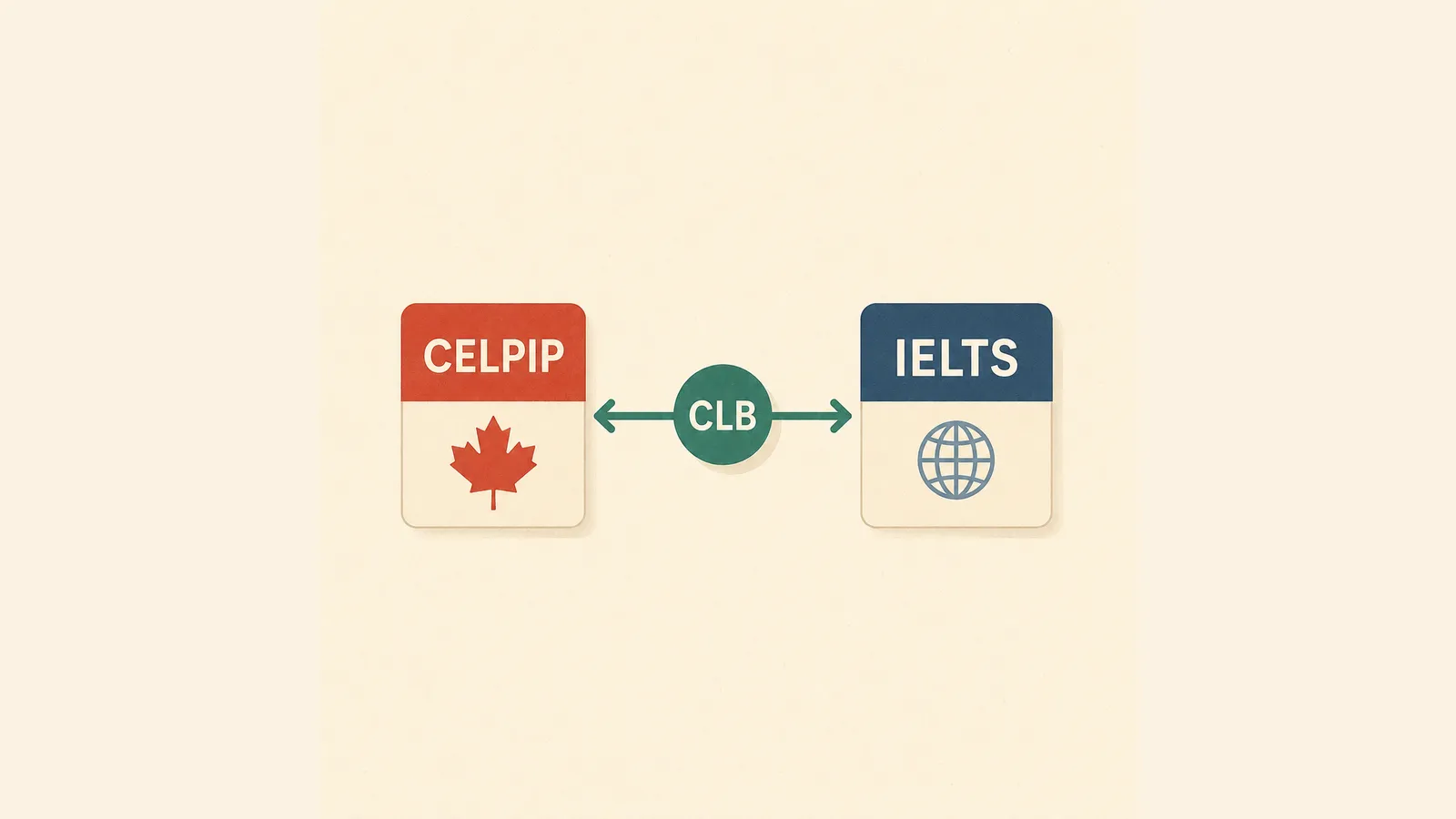
Both tests are valid for exactly the same purposes, and IRCC reads both through the same lens: the Canadian Language Benchmarks. Your application never says "CELPIP" or "PTE" points — it says CLB. So the choice is about which format lets you show your best English.
Where they're the same
More alike than any other pair of approved tests: both are fully computer-based, both wrap up in one sitting at a test centre, and on both you record your Speaking answers into a microphone with on-screen timers — no live examiner. If the face-to-face IELTS interview is what you're avoiding, either of these tests solves that.
Format: two hours vs three
PTE Core is the shorter test — about two hours: Speaking & Writing (~50 minutes), Reading (~30) and Listening (~30). The tasks come thick and fast: reading sentences aloud, repeating what you hear, describing an image, writing an email. Many are micro-tasks measured in seconds.
CELPIP-General runs about three hours, with longer, scenario-driven tasks — reading a letter and choosing responses, writing an email that solves a problem, giving advice to a friend. If your stamina fades, PTE's brevity is a real plus; if you think better with room to develop an answer, CELPIP's longer tasks suit that.
Scoring: human raters vs pure AI
This is the deepest difference, and most people miss it. PTE Core is scored entirely by Pearson's AI — trained on huge sets of human-marked responses, but no human ever reads your essay or hears your voice. CELPIP auto-scores Reading and Listening but puts your Writing and Speaking in front of certified human raters.
Neither approach is more generous, but they reward different habits. AI scoring is ruthlessly consistent and pattern-driven — clear pronunciation, complete sentences and safe structure convert well. Human raters can credit a well-developed idea or a natural turn of phrase even when it's unconventional — and they're assessing tone and task fulfilment the way a real reader would.
PTE Core to CLB: the official conversion
CELPIP needs no chart — a Level 9 is CLB 9. PTE Core reports each skill from 10–90, and IRCC converts it per skill:
| CLB | Listening | Reading | Writing | Speaking |
|---|---|---|---|---|
| 10 | 89–90 | 88–90 | 90 | 89–90 |
| 9 | 82–88 | 78–87 | 88–89 | 84–88 |
| 8 | 71–81 | 69–77 | 79–87 | 76–83 |
| 7 | 60–70 | 60–68 | 69–78 | 68–75 |
| 6 | 50–59 | 51–59 | 60–68 | 59–67 |
| 5 | 39–49 | 42–50 | 51–59 | 51–58 |
| 4 | 28–38 | 33–41 | 41–50 | 42–50 |
Look closely at the Writing column. To hit CLB 9 — the level that maxes your Express Entry language points — you need an 88 or 89 out of 90. CLB 10 requires a perfect 90. That's the narrowest top-end target on any approved test, and plenty of strong writers stall in the low 80s, which is only CLB 8. CELPIP's equivalent ask is a 9 on a 12-point scale, with four graded dimensions and room above it.
As always, your PR eligibility rides on your lowest skill — the program thresholds are per-skill, not averaged.
Cost, speed and booking
Fees are in the same neighbourhood: CELPIP-General is CAD $290 + tax (full fee breakdown); Pearson prices PTE Core by country, typically around CA$340+ in Canada — check their price finder when you book. PTE returns results faster — most within two business days versus CELPIP's few calendar days. Unless your deadline is measured in days, neither speed should decide it.
Which should you choose?
- Choose CELPIP if you want your Writing and Speaking judged by a human, you're strongest with everyday Canadian English and scenarios, you like a transparent 1:1 CLB scale — or your Writing is good-but-not-perfect and the PTE 88/90 ceiling worries you.
- Choose PTE Core if you want the shortest test and fastest results, you perform well on quick, structured micro-tasks, and machine-scored speaking doesn't rattle you.
And a practical tiebreaker nobody mentions: check real seat availability in your city for both tests. A test three weeks earlier can matter more than any format difference.
Whichever you pick, the lever that moves your score is the same — practising in the real format until nothing on test day feels new. If CELPIP is your pick, you can practise Reading and Listening free and get AI feedback on Writing and Speaking scored against the same CLB scale immigration uses.
Equivalency figures are IRCC's official PTE Core ↔ CLB chart and the CELPIP-General → CLB one-to-one mapping, current as of July 2026. Fees and policies change — confirm details with IRCC, Paragon and Pearson before you book.
Frequently asked questions
Is PTE Core accepted for Canadian PR?
Yes. Since January 2024, IRCC accepts PTE Core for all economic immigration programs that need an English test — Express Entry, PNPs and more — as well as for Canadian citizenship. It joined CELPIP-General and IELTS General Training as the third approved English test.
Which is easier, CELPIP or PTE Core?
Neither is officially easier — IRCC converts both to the same Canadian Language Benchmarks, so a CLB 9 is a CLB 9 on either test. They feel different, though: PTE Core is shorter with rapid-fire tasks and pure AI scoring, while CELPIP uses longer, Canadian-context tasks with human raters for Writing and Speaking.
What PTE Core score equals CELPIP 9 (CLB 9)?
Per IRCC's official equivalency, CLB 9 on PTE Core is Listening 82–88, Reading 78–87, Writing 88–89 and Speaking 84–88. On CELPIP, CLB 9 is simply Level 9 in each skill.
Is PTE Academic accepted for Canadian immigration?
No — for permanent residence you need PTE Core, not PTE Academic. PTE Academic is the study-focused version used for university admissions. The same split exists on the CELPIP side: PR requires CELPIP-General, while the shorter CELPIP-General LS only works for citizenship.
How long are CELPIP and PTE Core?
PTE Core runs about two hours: Speaking & Writing (~50 minutes), Reading (~30) and Listening (~30). CELPIP-General is about three hours across its four sections. Both are done on a computer in a single sitting at a test centre.
Does PTE Core use human markers?
No. PTE Core is scored entirely by Pearson's automated AI system — no human examiner sees your responses. CELPIP auto-scores Reading and Listening but uses certified human raters for Writing and Speaking.